Presented for online reading from a scanned copy of the American family newsletter. Text has been transcribed for clarity; the original layout is available as a PDF.
© Elwyn L. Bosomworth & Janice Gibson Cloud · 400 Mountain Dr., Santa Barbara, CA 93103
Shared here for family research. Please respect the original copyright.
Well for some, it’s how you say it that counts. Bosomworth lends itself to that and reports have been trickling in that, to some, it makes a difference. Pronunciations seem to vary primarily with the first syllable — “Dah” or “Buh” somworth.
Creative genealogy seems to run in our family and one cousin relates that “to care for the lurid imagination of my male associates in college, I created a lineage that was lost in a bothel in ‘mid-evil’ times. This was embellished with Henry VII’s tax collectors demanding payment and so on. This lineage improved upon each telling. Strangely enough, everybody loved the story and it was never challenged, especially since the name is carried by the male line and the endowment is carried by the female. But that is the way of fairy tales.”
Another cousin hypothesized along the same lines in pondering “whether we came from a distant line of buxom medieval ladies of the night? Sadly not”, he concludes.
On this site we also keep Charles’s explanation: What does the name Bosomworth mean?
David Bosomworth of British Columbia (Canada) reports that on a visit to England in the 1960s he was told that there were “dark” and “light” Bosomworth families who were not related to each other. His line was supposed to fall in the “dark” category and he interpreted that designation as being a characteristic of complexion. Has any one else information about this custom?
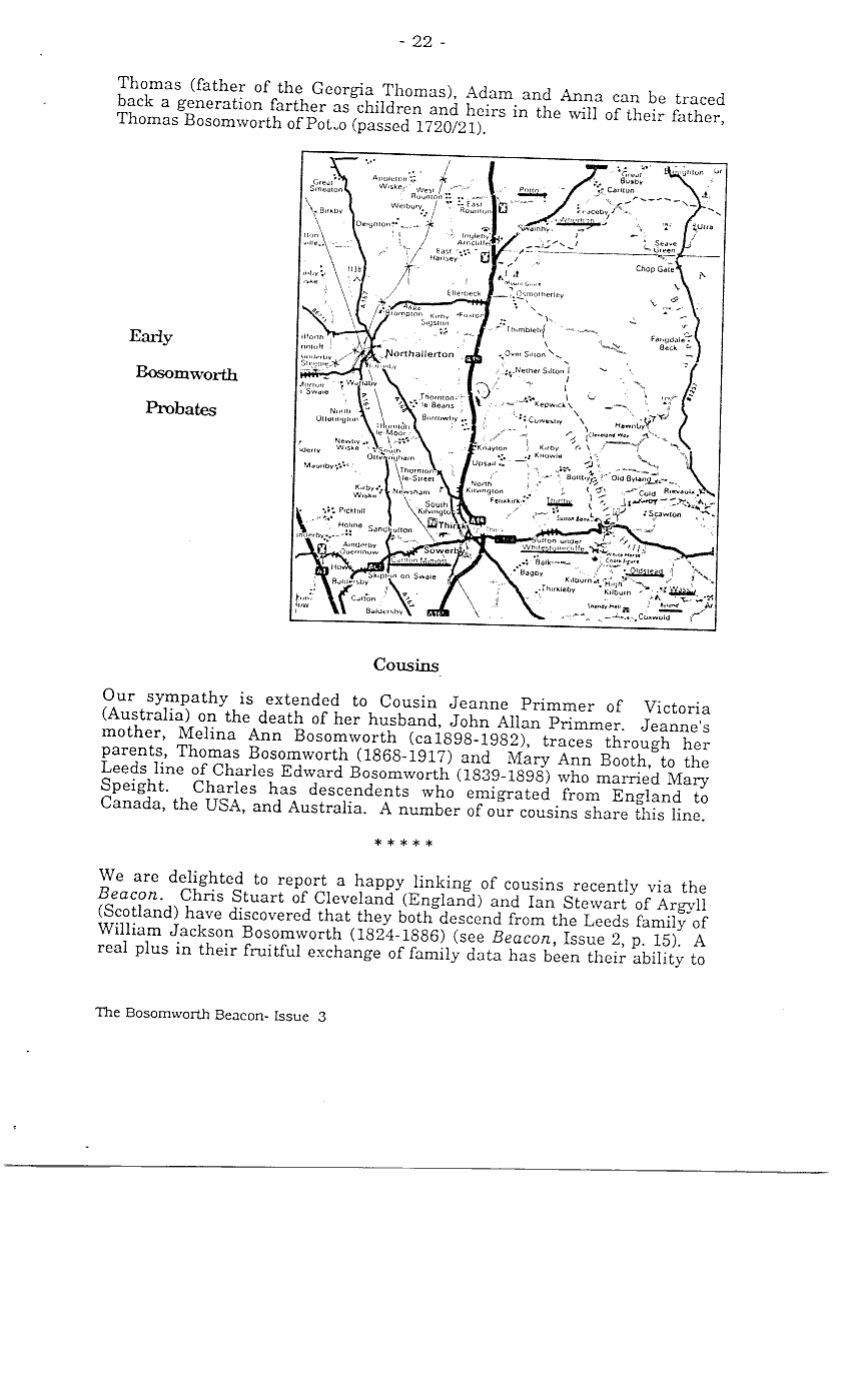
In Issue 2 of the Beacon we talked about the earliest Bosomworth parish register entries as a possible indicator of the original location of Bosomworth as a surname. Bosomworth entries from 1580 (Kirby Sigston) and 1598 (Felixkirk) are the earliest yet located from parish records.
Probate records (wills and administrations) are another source for the study. Probate takes two forms: wills and administrations. A will is made if the deceased planned ahead; an administration is needed if they neglected this step.
The earliest Yorkshire will for the Bosomworth family located is dated 7 Feb 1389 for Adam de Bosseworth (Sausemaker of York). Spelling varies (Bosseworth, Bossonworth, Bosworth, Bosomworth, and so on); this is likely close to the origin of the surname.
The next earliest Bosomworth wills and administrations located in Yorkshire probate indexes are listed below. (W = Will, A = Administration.)
| Date of probate | Name, residence, parish | Type |
|---|---|---|
| 1527 June 22 | William of Aldeburghe | W |
| 1562 Oct 3 | Jenet of Sutton under Whitestonecliff, widow | W |
| 1591 Apr 13 | William of Sutton under Whitestonecliff | W |
| 1634 July 17 | Adam of Sutton under Whitestone Cliff | W |
| 1661 Sept 13 | Anthonie of Thirleby, linnendraper | W |
| 1671 Oct 31 | William of Wasse, linnendraper | W |
| 1691 Dec 4 | William of Camshead, Bulmer deanery | A |
| 1720/21 | Thomas of Potto (near Whorlton) | A |
| 1736 May | William of Sutton under Whitestonecliff | W |
| 1736/7 Feb | George of Thirleby, parish Feliskirk | A |
| 1737 July | William of Thirleby, parish Feliskirk | A |
| 1737/8 Feb | Alice of Thirleby, parish Feliskirk | A |
| 1748 May | Thomas of Goulton, parish Whorlton | W |
| 1754 Nov | Adam of Hammersmith, Middlesex | W |
| 1757 Mar | Christopher, foreign parts (mariner) | W |
| 1762 Feb | William of Sutton under Whitestonecliffe, Feliskirk | W |
| 1766 Nov | John of Olstead, parish Kilburn | A |
| 1779 Oct | William of Hood Grange, parish Kilburn | W |
| 1782 Dec | Leonard of Carlton Miniott, parish Thirsk | W |
| 1793 Sept | George of Byland, parish Coxwold | W |
| 1795 Jan | John of York | W |
| 1795 July | Adam of York | W |
Note: Aldeburghe was a parish in the district of Skirlaugh near Hull in the East Riding.
Indexes used by the Beacon editors included:
The LDS Church (Church of Jesus Christ of Latter-day Saints) has microfilmed extensively in Yorkshire; their holdings contain a nearly complete collection of early probate for the county. On a research trip to Salt Lake City, the editors obtained copies of the wills and administrations listed (and others up to 1858 when centralised civil registration began for probate).
Probate was not centralised when handled by ecclesiastical courts. Goods solely in the home parish went to the lowest court; possessions across more than one parish went higher; goods across county lines or death at sea often went to the Prerogative Court of Canterbury — with exceptions and Peculiar Courts also in the chain.
Records survive as originals and as “register copies” in official probate registers. Most of the oldest Yorkshire probate is now at the Borthwick Institute of Historical Research, University of York. Original wills there may have inventories and other papers bundled with them.
Early Bosomworth wills are in English (with probate details often in Latin); early administrations are primarily in Latin. Both use many abbreviations. The editors thanked the British Reference Desk staff in Salt Lake City for help reading the script.
William Bosomworth of Sutton under Whitestonecliffe, Yorkshire, yeoman — will dated 15 December 1591, proved 13 April 1592.
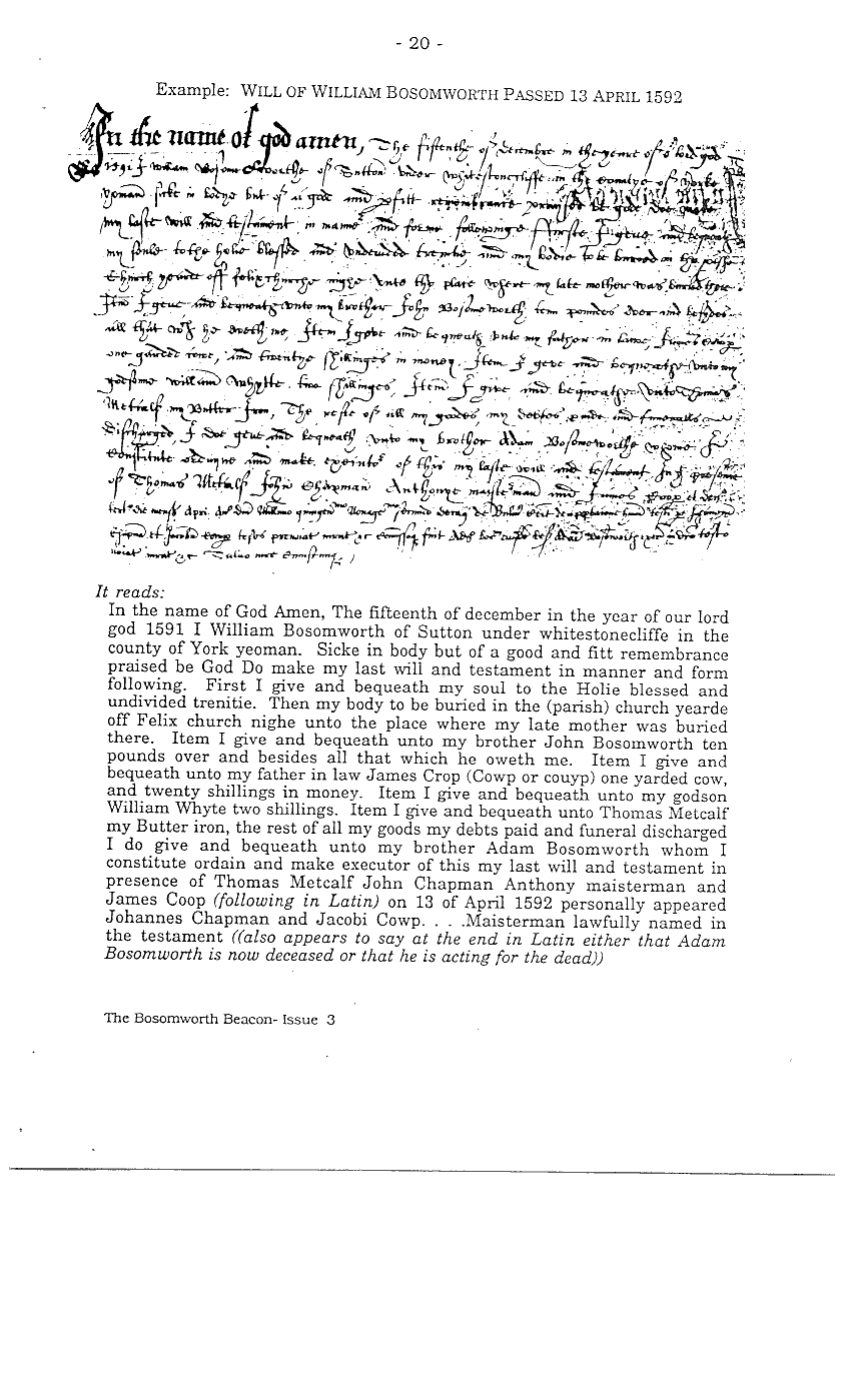
In the name of God Amen, The fifteenth of december in the year of our lord god 1591 I William Bosomworth of Sutton under whitestonecliffe in the county of York yeoman. Sicke in body but of a good and fitt remembrance praised be God Do make my last will and testament in manner and form following. First I give and bequeath my soul to the Holie blessed and undivided trinitie. Then my body to be buried in the (parish) church yearde off Felix church nighe unto the place where my late mother was buried there. Item I give and bequeath unto my brother John Bosomworth ten pounds over and besides all that which he oweth me. Item I give and bequeath unto my father in law James Crop one yarded cow, and twenty shillings in money. Item I give and bequeath unto my godson William Whyte two shillings. Item I give and bequeath unto Thomas Metcalf my Butter iron, the rest of all my goods my debts paid and funeral discharged I do give and bequeath unto my brother Adam Bosomworth whom I constitute ordain and make executor of this my last will and testament…
Witnesses / probate names include Thomas Metcalf, John Chapman, Anthony Maisterman, and James Coop. Burial requested at Felixkirk churchyard near his mother.
Evidence that Bosomworths ventured much beyond Yorkshire before 1800 is scant. Thomas Bosomworth and his appearance in the official records of colonial Georgia is a noted exception. He is reported to have sailed from England in 1741, returned in 1742 to receive Holy Orders, and journeyed again to Georgia in 1743. Thomas and his wife Mary lobbied the colonial government for a substantial land grant based on Mary’s Creek Indian heritage and her service as scout and interpreter to General Oglethorpe. (They eventually received St Catherine’s Island off the coast of Georgia. For a fuller account, see Beacon, Issue 1.)
The will of Thomas Bosomworth of Goulton, parish of Whorlton (signed 17 Mar 1747; “passed the seal” 7 May 1748) appears to connect this line. Among the bequests:
The reference to sister Anna Myeick links to the will of Adam Bosomworth of Hammersmith, Middlesex (passed 9 Nov 1754), leaving everything to “my beloved sister Anna Myrick now residing with me at Hammersmith”.
Thomas (father of the Georgia Thomas), Adam and Anna can be traced back a generation farther as children and heirs in the will of their father, Thomas Bosomworth of Potto (passed 1720/21).
Sympathy was extended to Cousin Jeanne Primmer of Victoria (Australia) on the death of her husband, John Allan Primmer. Jeanne’s mother, Melina Ann Bosomworth (ca 1898–1982), traces through Thomas Bosomworth (1868–1917) and connections into lines with descendants in Canada, the USA, and Australia.
Chris Stuart of Cleveland (England) and Ian Stewart of Argyll (Scotland) discovered via the Beacon that both descend from the Leeds family of William Jackson Bosomworth (1824–1886) (see Beacon, Issue 2).
A.J. Bosomworth of Skipton, North Yorkshire traces via grandfather Albert (b. 1882, Riccal), through Thomas Bosomworth (bapt. 1853, Bagby) who married Elizabeth Ann Massu, to William Bosomworth (b. ca 1828, Crayke, shoemaker) and Jane Freer. William’s father is listed as Charles Bosomworth. Arthur Bosomworth of Bradford stems from this line as well.
Hubert was the son of Robinson Bosomworth (b. ca 1849, Sand Hutton — see Beacon, Issue 2).
This site’s own family pages also follow the Sandhutton / Robinson Bosomworth line (see Robinson Bosomworth and the Family pages).
Civil registration of marriages in England began in July 1837. Nation-wide indexes give year, quarter, registration district, volume and page. With those references, a copy of the certificate can be ordered. The Beacon editors held Bosomworth marriage index entries from 1837 through 1900.
Certificate details include date and place of marriage, names and occupations of bride and groom, age (sometimes “of full age”), residence, and fathers’ names and occupations. Occupation can help distinguish among many Johns, Williams and Georges — trades such as shoemaking ran in some Bosomworth families.
Two cousins from England — Chris Stuart and Beryl Ward — offered help gathering Bosomworth data. The editors invited others to contribute and asked readers to pass on names of kin interested in the family history.
They also invited contact so that “Cousin Jan Cloud” could check the Bosomworth Family Files for helpful material.
On this site
· Download the original scanned PDF (8 pages)
· What does the name Bosomworth mean? (Charles’s note)